



The travel industry has undergone a major transformation over the last decade. Travelers no longer visit ticket counters or rely on travel agents for every booking. Today, flights, hotels, transfers, holiday packages, travel insurance, and activities can be booked instantly through digital platforms.
This shift has created significant demand for travel portal development solutions that connect travelers, travel agencies, suppliers, aggregators, and travel management companies through a unified booking platform.
Industry Statistics (2026)
The global online travel booking platform market reached $641.07 billion in 2025 and is projected to hit $702.67 billion in 2026, growing at a 9.6% CAGR. The market is expected to reach $1 trillion by 2030. Online channels now generate roughly 70% of total travel and tourism revenue globally. Additionally, 68% of travel searches now originate on mobile devices, and mobile platforms account for 63% of all online travel bookings in 2026.
Table of Contents
What Is Travel Portal Development?
Travel portal development is the process of building a web or mobile-based booking platform that allows users to search, compare, book, and manage travel services from a single interface. The platform connects with airlines, hotels, car rental companies, tour operators, and other travel suppliers through APIs, Global Distribution Systems (GDS), and New Distribution Capability (NDC) integrations.
How Does a Travel Portal Work?
A travel portal receives user search requests and sends them to multiple travel suppliers simultaneously through connected APIs. The platform collects real-time inventory data, applies business rules such as markups or commissions, and displays the most relevant options to the user. Once a booking is confirmed, the system processes payment, generates a booking reference or Passenger Name Record (PNR), and delivers the confirmation instantly.
What Services Can a Travel Portal Offer?
Depending on the business model, a travel portal can provide access to:
- Flight bookings
- Hotel reservations
- Car rentals
- Bus ticket bookings
- Rail ticket bookings
- Holiday packages
Travel portal development involves creating a centralized travel booking platform that integrates airlines, hotels, transportation providers, and travel service suppliers through APIs. It enables real-time search, booking, payment processing, itinerary management, and automated reservation fulfillment for both consumers and travel businesses.
Why Travel Businesses Need Digital Transformation
Digital transformation has become a critical priority for travel companies. Travelers now expect instant search results, real-time availability, personalized recommendations, and seamless booking experiences across web and mobile platforms.
At the same time, travel businesses face growing operational challenges. Managing inventory across multiple suppliers, processing bookings manually, handling customer inquiries, and tracking financial transactions can increase costs and slow business growth.
Digital transformation in travel refers to the adoption of modern technologies, automation, cloud platforms, APIs, data analytics, and AI-driven tools to improve business operations and customer experiences.
Types of Travel Portals
Travel distribution platforms must be custom-tailored to align with specific commercial distribution channels, audience segments, and compliance frameworks.
1. B2C Travel Portal (Business-to-Consumer)
Engineered for the public retail consumer, B2C portals focus on interface performance, low-friction checkout flows, and elastic search filters. Because retail consumers search significantly more than they purchase, these public instances require aggressive caching architectures to handle high search-to-book ratios without driving up third-party supplier API lookup costs.
- Primary Use Cases: Direct-to-consumer Online Travel Agencies (OTAs), niche single-vertical booking sites (e.g., local hotel finders), and standalone dynamic package builders.
- Core Technical Features: Multi-currency payment processing gateways, integrated guest checkouts, social authentication protocols, and real-time review aggregation.
2. B2B Travel Portal (Business-to-Business)
Built for sub-agents, franchise networks, and global travel distributors, B2B portals restrict access to authenticated, professional users. These private portals prioritize deep back-office accounting control, multi-tier agent permission setups, and granular financial accounting over pure visual design.
- Primary Use Cases: Wholesale travel consolidators, regional destination management companies (DMCs), and host agency distribution networks.
- Core Technical Features: Multi-level markup engines, deposit and credit limit allocation tracking, sub-agent wallet management, automated commission distribution ledgers, and advanced tax rule engines (e.g., VAT/GST tracking).
3. B2B2C Travel Portal (White-Label Networks)
A hybrid, multi-tier deployment model that enables an enterprise aggregator to license independent, branded instances of its booking engine to downline agents. This allows smaller agencies to run a fully functional OTA without building an independent API infrastructure.
- Primary Use Cases: Global franchise travel networks, affiliate program managers, and airline/hotel loyalty reward storefronts.
- Core Technical Features: Custom domain mapping (CNAME architecture), independent tenant database partitioning, drag-and-drop client branding controls, and centralized master-agent inventory provisioning panels.
4. Corporate Travel Portal (TMC Booking Tools)
Custom environments built specifically for enterprise business travelers, procurement officers, and Travel Management Companies (TMCs). These platforms focus heavily on structural risk mitigation, expense monitoring, and corporate compliance automation.
- Primary Use Cases: Enterprise-grade corporate travel tools, government travel portals, and specialized professional service expense tools.
- Core Technical Features: HR system integrations (e.g., Workday, Active Directory sync), real-time corporate travel policy auto-enforcement, multi-level management approval loops, integrated expense reporting syncs (e.g., Concur), and employee duty-of-care tracking map systems.
How Travel Portal Development Works
A travel portal processes thousands of search requests, pricing updates, and booking transactions every day. To deliver real-time availability and accurate pricing, the platform communicates with multiple travel suppliers, payment gateways, and booking systems through APIs.
The workflow below shows how a modern travel booking engine searches inventory, aggregates results, processes payments, generates PNRs, and completes reservations automatically
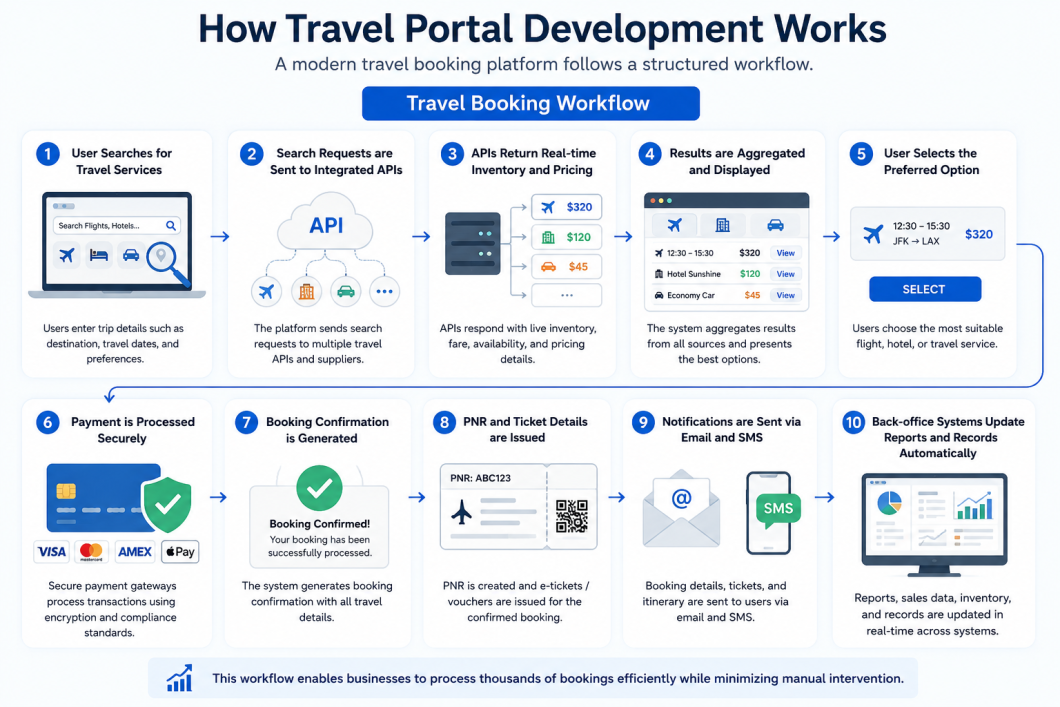
The workflow above illustrates how a travel booking engine coordinates supplier APIs, inventory aggregation, pricing logic, payment processing, and reservation fulfillment. Each stage plays a critical role in ensuring accurate availability, successful bookings, and a seamless customer experience.
Travel Portal Architecture Explained
To process thousands of concurrent searches without experiencing system lag, the platform must use a decoupled, 5-layer microservices architecture.
1. Presentation Layer: Fast frontend user interfaces built with React or Next.js for web, and Flutter or React Native for mobile apps.
2. Application Layer: The logic core that runs the booking lifecycle, coordinates the dynamic pricing matrix, and enforces business rules.
3. Integration Layer: The API broker. It translates internal JSON queries into legacy EDIFACT (GDS), custom XML/SOAP (Bedbanks), and modern REST JSON (NDC) protocols, while deduplicating identical properties.
4. Data Layer: A hybrid setup using relational databases (PostgreSQL) for ACID-compliant financial records, and in-memory databases (Redis) to cache transient supplier availability.5. Infrastructure Layer: Cloud environment using Docker and Kubernetes to automatically scale microservices horizontally during peak seasonal holiday traffic spikes.
Essential APIs for Travel Portal Development
A travel portal’s inventory depth and pricing competitiveness depend on its API ecosystem. Modern platforms deploy a multi-provider API strategy to ensure global coverage and structural redundancy.
1. Flight Distribution APIs
- Amadeus, Sabre, & Travelport: Primary global GDS networks required for international legacy carrier routing, worldwide schedules, and global fare contracts.
- Mystifly & Travelfusion: Specialized consolidators that aggregate low-cost carrier (LCC) web content and non-GDS flight inventories into standard REST pipelines.
- TBO Air: Global content aggregator providing streamlined, high-availability retail and wholesale flight options across regional corridors.
2. Accommodation & Hotel Bedbank APIs
- Hotelbeds: Leading global B2B bedbank providing wholesale contract rates, localized regional pricing, and direct room allocations.
- Expedia Partner Solutions (EPS): Retail lodging aggregator surfacing over one million properties alongside rich media assets, amenity mappings, and verified reviews.
- Agoda, DOTW, & Stuba: Regional specialists providing deep inventory pipelines across Asian (Agoda), Middle Eastern (DOTW), and European (Stuba) hospitality markets.
- TBO Hotels: B2B global accommodation platform consolidating worldwide properties into a single, high-availability web-service stream.
3. Operational & Core Infrastructure APIs
- Payment Processing: Stripe, Adyen, or PayPal featuring split-settlement routing to automatically segment agent commissions and wholesale supplier costs.
- Communication Routing: Twilio (SMS/WhatsApp) and SendGrid (Email) for automated transaction receipts, booking vouchers, and flight alerts.
- Financial & Auxiliary Utilities: XE Currency for live checkout conversions, and Google Maps for precise property location plotting.
- Protection & Logistics: Insurance APIs (Allianz, Chubb) for automated coverage attachments, and Visa APIs (iVisa) for localized document submission workflows.
- Customer Management: CRM Platforms (Salesforce, HubSpot) to track guest reservation histories, corporate travel groups, and user search behavior.
GDS vs NDC: Understanding Modern Airline Distribution
Airline distribution continues to evolve.
| Feature | GDS | NDC |
| Content Source | Aggregated | Direct Airline |
| Ancillary Services | Limited | Extensive |
| Personalization | Basic | Advanced |
| Airline Control | Lower | Higher |
| Dynamic Pricing | Limited | Strong |
Many modern travel platforms combine both GDS and NDC integrations to maximize content availability.
Key Features of a Modern Travel Portal
An enterprise travel platform must provide tailored, high-performance features across customer, agent, and administrator environments.
1. Core Customer Features
- Multi-City Search Engine: Builds complex, open-jaw itineraries across separate providers in a single checkout.
- Live Availability Sync: Pulls sub-second room and seat inventory directly from suppliers to eliminate booking failures.
- Self-Service Modification Hub: Automates user-driven rebookings, upgrades, and cancellations based on live supplier policies.
- Multi-Currency Core: Renders localized currency conversions and supports global credit networks, bank rails, and digital wallets.
2. B2B Agent Features
- Dynamic Markup Matrix: Configures tiered, programmatic pricing adjustments by destination, supplier, or booking window.
- Credit & Deposit Control: Allocates secure credit lines to sub-agents, pausing booking rights if balances cross thresholds.
- Split Commission Router: Calculates, tracks, and routes transactional commissions to sub-agent wallets instantly upon booking.
- White-Label Customization: Provides custom domain mapping (CNAME) and layout tools for downstream agent branding.
3. Central Admin Controls
- API Channel Manager: Routes search traffic and takes failing supplier connections offline via dashboard toggles without code changes.
- Automated Financial Reconciliation: Matches public payments against wholesale costs and agent commissions to generate clean ledgers.
- Live System Observability: Tracks look-to-book ratios, API latency variations, error rates, and channel profitability in real time.
Travel Portal Development Process
Building an enterprise-grade booking engine requires a systematic, multi-phased engineering pipeline. This structured approach prevents transactional drift, minimizes data-mapping overhead, and ensures absolute data synchronization between client interfaces and upstream supplier networks.
Step 1: Requirement Analysis
Define distribution vectors (B2C, B2B, or Corporate), geographic user bases, localized tax rules, and currency conversion models. Output a strict technical blueprint mapping system requirements, third-party interface limits, and target traffic estimates.
Step 2: Supplier & API Selection
Secure production-grade credentials from Global Distribution Systems, airline direct NDC lines, and hotel bedbanks. Technical leads audit supplier endpoints for performance, message response payloads, lookup limit constraints, and localized inventory depth.
Step 3: UI/UX Architecture
Design wireframes and interface logic optimized for conversion metrics. Engineers map out high-frequency user screens, including advanced multi-city input filters, sticky comparison tables, dynamic baggage up-sell models, and three-click mobile checkout paths.
Step 4: Core Travel API Integration
Develop the API broker and normalization architecture. Software teams construct asynchronous worker routines to pool concurrent third-party requests, execute deduplication scripts on raw property data, implement pricing markup logic, and connect payment settlement pipelines.
Step 5: QA & Load Testing
Run automated testing matrices across all inventory types. Engineers inject simulated connection timeouts, payload dropouts, and heavy concurrency load blocks to guarantee that payment states and booking holds remain completely synchronized under heavy usage.
Step 6: Cloud Deployment
Publish microservices to secure production systems using automated CI/CD pipelines. Set up container isolation arrays, deploy auto-scaling rules based on processing strain, establish globally distributed Content Delivery Networks (CDNs), and activate edge firewalls.
Step 7: Support & SLA Monitoring
Maintain system performance through automated logging and alert routines. Development teams track API latency fluctuations, update data structures to match upstream carrier API changes, adjust caching windows, and deploy regular security updates.
Travel Portal Development Cost in 2026
The capital allocation required to build a travel booking engine depends on your target business model, the number of integrated APIs, and required system customization.
Cost Breakdown Matrix
| Portal Architecture Type | Estimated Cost Range (USD) | Target Deployment Scenario |
| Basic B2C Portal | $10,000 – $25,000 | Regional setups deploying standard, single-API retail frameworks. |
| Advanced B2B Portal | $20,000 – $50,000 | Mid-market wholesalers requiring agent hierarchies, wallet systems, and markup engines. |
| B2B2C Hybrid Platform | $40,000 – $100,000+ | Large operators launching automated white-label sub-franchises via custom domains. |
| Enterprise Custom Engine | $100,000+ | High-volume multi-product OTAs deploying decoupled microservices architectures. |
White Label vs. Custom Travel Portal
Choosing between a pre-packaged software framework and a bespoke application deployment is a critical strategic decision. The right selection depends directly on your initial capital, speed-to-market goals, and long-term scaling requirements.
Strategic Selection Matrix
| Comparison Metric | White Label Travel Portal | Custom Bespoke Platform |
| Time-to-Market | 1–3 Weeks: Deploys pre-certified booking flows instantly. | 3–6 Months: Requires complete design, mapping, and testing cycles. |
| Initial Capital Expense | Low: Minimal setup fees; structured on predictable SaaS subscriptions. | High: Requires dedicated engineering teams and infrastructure investment. |
| Intellectual Property | None: The underlying system code is owned entirely by the SaaS vendor. | Full Ownership: Your business owns the source code, data schemas, and assets. |
| User Experience (UX) | Standard: Restricted to pre-built, multi-tenant design templates. | Infinite Freedom: Tailored layouts designed around your specific conversion paths. |
| API Customization | Rigid: Limited to the supplier pipelines natively supported by the vendor. | Unrestricted: Allows connection to any global GDS, NDC, or local bedbank API. |
AI Trends Transforming Travel Portal Development
In 2026, artificial intelligence serves as a core optimization layer that drives conversion metrics and automates backend margin operations.
Key AI Applications in Travel Portals
- AI-Powered Search: Understands natural language queries and delivers more relevant travel options.
- Dynamic Pricing: Adjusts pricing and markups based on demand, seasonality, and market trends.
- Conversational Booking: AI assistants help users search, compare, and book travel services through chat-based interactions.
- Personalized Recommendations: Suggests flights, hotels, packages, and ancillary services based on user behavior and preferences.
- Automated Customer Support: AI chatbots handle booking inquiries, cancellations, itinerary changes, and common support requests.
As AI capabilities continue to evolve, travel portals are shifting from simple booking engines to intelligent platforms that improve customer experience, increase conversions, and support operational efficiency.
Common Travel Portal Development Challenges
Building a travel portal involves more than connecting APIs and launching a booking engine. Travel businesses must manage supplier dependencies, high search volumes, inventory accuracy, and transaction reliability at scale.
Some of the most common challenges include:
- API Rate Limits: Suppliers often restrict API requests, making caching and request optimization essential.
- Inventory Duplication: Multiple suppliers may return the same flight or hotel, requiring inventory normalization and deduplication.
- Supplier Downtime: API failures can disrupt bookings, making supplier redundancy and failover mechanisms critical.
- Payment Reconciliation: Managing customer payments, supplier invoices, commissions, and refunds requires automated financial workflows.
- Scalability Bottlenecks: Seasonal demand spikes can overload systems without cloud-native architecture and auto-scaling.
- Search-to-Book Ratio Issues: High search volumes generate significant API costs, making intelligent caching and search optimization important.
Final Thoughts
Travel portal development is no longer limited to creating an online booking website. Modern travel platforms combine API integrations, automation, cloud infrastructure, AI-powered personalization, and advanced business management tools to deliver seamless travel experiences.
Whether you are building a B2B travel portal, B2C booking platform, corporate travel system, or a complete OTA solution, selecting the right technology architecture and development partner plays a critical role in long-term success.
Businesses that invest in scalable travel technology today will be better positioned to compete in an increasingly digital travel ecosystem.
FAQs
1. What is travel portal development?
Travel portal development is the process of building a web or mobile platform that allows users to search, compare, book, and manage travel services from a single interface. These platforms integrate with GDS, NDC, airlines, hotels, payment gateways, and other travel APIs to provide real-time booking capabilities.
2. How much does travel portal development cost?
Travel portal development costs vary based on business requirements, API integrations, and platform complexity. A basic travel booking platform may cost between $10,000 and $25,000, while a custom enterprise-grade OTA or B2B travel portal with multiple supplier integrations can exceed $100,000.
3. Which APIs are required for a travel portal?
Most travel portals integrate flight APIs such as Amadeus, Sabre, Travelport, or NDC airline APIs. Hotel inventory often comes from providers like Hotelbeds, Expedia Partner Solutions, Agoda, or TBO Hotels. Additional integrations may include payment gateways, maps, insurance, CRM systems, and communication APIs.
4. What is the difference between a GDS and an NDC API?
A GDS (Global Distribution System) aggregates flight inventory from multiple airlines through a centralized platform. NDC (New Distribution Capability) connects directly to airlines and supports richer content, personalized offers, ancillary services, and dynamic pricing. Many modern travel portals use both to maximize inventory coverage.
5. Should I build a custom travel portal or choose a white-label solution?
A white-label travel portal is suitable for businesses that need faster deployment and lower upfront costs. A custom travel portal offers greater flexibility, full ownership, advanced integrations, and scalability. Businesses planning long-term growth, unique workflows, or multi-supplier ecosystems typically benefit more from custom development.