


Selecting the ideal blockchain development platform is a foundational decision for enterprise technical architects and business leaders. The underlying distributed ledger technology (DLT) framework dictates an application’s scalability, security posture, compliance capabilities, and long-term operational costs.
Choosing a misaligned platform can lead to architectural bottlenecks, vendor lock-in, or severe compliance violations. This comprehensive guide provides a comparative evaluation of the leading blockchain platforms, offering a structured framework to align business requirements with technical execution.
Table of Contents
What Is a Blockchain Development Platform?
A blockchain development platform is a specialized software framework that allows developers to build, deploy, and maintain decentralized applications (dApps) and smart contracts. Instead of engineering a distributed ledger network from scratch, these platforms provide pre-configured infrastructure, consensus engines, cryptographic frameworks, and application programming interfaces (APIs).
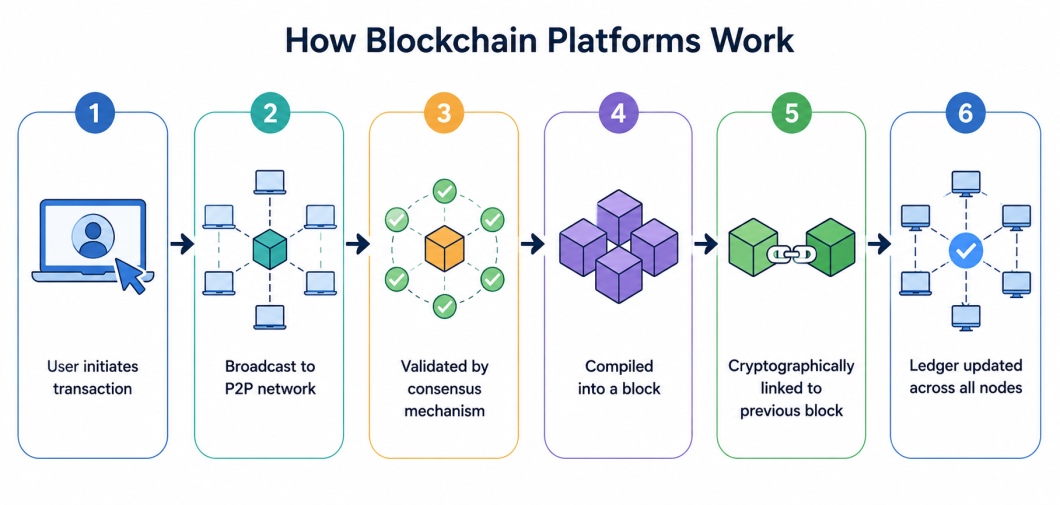
How Blockchain Platforms Work
Blockchain platforms operate by maintaining a synchronized, immutable ledger across a distributed network of peer-to-peer nodes. When a user or system triggers an action, the platform processes the data through a specific sequence.
Core Components of a Blockchain Ecosystem
- Consensus Mechanism: The protocol algorithm (e.g., Proof of Stake, Practical Byzantine Fault Tolerance) that ensures all network participants agree on the validity of transactions.
- Smart Contracts: Self-executing digital scripts containing the logic and business rules of an agreement, hardcoded directly onto the ledger.
- Cryptographic Keys: Asymmetric cryptography using public and private keys to secure asset ownership and authenticate data changes.
- Nodes: The individual servers within the network that store copies of the ledger, validate transactions, and enforce runtime state changes.
Why Businesses Need Blockchain Applications
Traditional centralized databases create single points of failure, require complex third-party reconciliations, and remain vulnerable to unauthorized data alterations. Enterprise blockchain applications address these structural vulnerabilities by enforcing a single, tamper-proof source of truth among mutually distrustful business entities.
Key Benefits of Blockchain Development
- Elimination of Intermediaries: Peer-to-peer validation eliminates settlement clearinghouses and administrative brokers, lowering operational overhead.
- Immutability and Auditability: Cryptographic hashing ensures data cannot be retroactively altered, creating an immutable audit trail for compliance.
- Automated Operational Efficiency: Smart contracts automate complex multi-party workflows, accelerating execution times from days to real-time.
Blockchain Adoption Statistics and Market Growth
The momentum shifting toward distributed infrastructure is supported by strong market indicators:
- The global blockchain technology market is experiencing rapid enterprise adoption, with multiple research firms projecting sustained growth through 2030 as regulatory frameworks mature and infrastructure improves.
- Industry surveys indicate that 20-30% of enterprises have blockchain initiatives in production or pilot phases, with adoption rates varying significantly by industry vertical.
- National blockchain initiatives in China (Blockchain-based Service Network), EU (European Blockchain Services Infrastructure), and India (Blockchain Repository) are deploying distributed ledger technology for identity, land registry, and supply chain verification at scale.
How to Choose the Right Blockchain Platform
Selecting the right platform requires balancing technical trade-offs based on the specific needs of your application.
Scalability Requirements
Analyze the platform’s throughput capabilities. High-volume business apps need networks that can scale horizontally or utilize Layer 2 scaling layers without suffering from compounding gas fees or processing delays.
Security Requirements
Evaluate the underlying cryptoeconomic or permissioned security structure. While public validation models provide high resilience against censorship, enterprise use cases typically favor private, role-based access control (RBAC) frameworks to safeguard sensitive data.
Transaction Speed
Calculate the platform’s transaction finality, the time it takes for a transaction to become irreversible. Financial clearing tools require low latency and rapid finality, whereas data logging workflows can tolerate longer settlement periods.
Smart Contract Support
Assess the programming environments supported by the ecosystem. Platforms that support established languages like Go, Java, or Rust reduce onboarding frictions, whereas specialized execution environments like EVM require teams skilled in Solidity.
Regulatory Compliance
Ensure the architecture can comply with strict data privacy laws such as GDPR and HIPAA. For example, GDPR’s “right to be forgotten” contradicts blockchain’s native immutability, making hybrid or private setups necessary to isolate personally identifiable information (PII) off-chain.
Best Blockchain Platforms for Application Development
Here are some of the top blockchain platforms, each offering unique features, capabilities, and use cases.
Ethereum
Ethereum is the industry-standard, decentralized public blockchain platform that pioneered programmable smart contracts. It operates as a global, permissionless execution environment.
- Key Features: Ethereum Virtual Machine (EVM), ERC token standards, Proof of Stake (PoS) consensus, and massive developer tooling ecosystems.
- Advantages: Unmatched decentralization, highly secure, global interoperability, and an expansive developer talent pool.
- Limitations: High and unpredictable gas fees during network congestion; base-layer throughput is limited without relying on Layer 2 networks.
- Best Use Cases: Decentralized Finance (DeFi), public asset tokenization, and global decentralized applications (dApps).
Hyperledger Fabric
Hosted by the Linux Foundation, Hyperledger Fabric is a modular, permissioned enterprise-grade distributed ledger framework designed for private consortia.
- Key Features: Pluggable architecture, private channels for confidential transactions, and support for standard smart contracts (Chaincode) written in Go, Java, and Node.js.
- Advantages: Strict enterprise privacy controls, high transaction throughput, and zero volatile transaction fees.
- Limitations: Complex infrastructure orchestration and lack of native public interoperability.
- Best Use Cases: Multi-enterprise supply chain tracking, B2B cross-border clearing, and regulatory compliance networks.
Ripple
Ripple is a specialized enterprise payment network optimized for instantaneous global financial settlements.
- Key Features: Ripple Protocol Consensus Algorithm (RPCA), native asset (XRP) for bridging fiat currencies, and high-performance financial tooling.
- Advantages: Sub-second transaction settlements, predictable sub-penny costs, and deep integration with institutional banking systems.
- Limitations: Limited support for complex smart contracts compared to Ethereum, though XRP Ledger now supports Hooks for extended functionality
- Best Use Cases: Interbank cross-border remittances, real-time gross settlement (RTGS) systems, and liquidity management.
EOS
EOS is a high-performance, public blockchain platform engineered for commercial-scale decentralized applications requiring rapid throughput.
- Key Features: Delegated Proof of Stake (DPOS) consensus engine, WebAssembly (WASM) execution environment, and zero-fee transaction models for end-users.
- Advantages: Exceptional throughput capabilities, minimal latency, and an upgradeable smart contract architecture.
- Limitations: Higher degree of block producer centralization compared to Ethereum.
- Best Use Cases: High-frequency gaming applications, consumer dApps, and decentralized social media networks.
Corda (by R3)
Corda is an enterprise-grade, permissioned distributed ledger platform designed specifically for regulated financial institutions.
- Key Features: Notary services for consensus, point-to-point encrypted transactions, and support for Java/Kotlin smart contracts (CorDapps).
- Advantages: Designed for regulatory compliance, privacy-first architecture (transactions only visible to involved parties), and strong banking industry adoption.
- Limitations: Smaller developer ecosystem compared to Ethereum, specialized learning curve for CorDapp development.
- Best Use Cases: Banking and financial services, insurance claims processing, trade finance, and regulatory reporting networks.
Blockchain Platform Comparison Table
| Platform | Network Type | Consensus Mechanism | Smart Contract Support | Scalability (TPS) | Security Model | Ideal Enterprise Use Case |
| Ethereum | Public | Proof of Stake (PoS) | Yes (Solidity, Vyper) | ~15 (Base Layer) | High (Global Validation) | Public Tokenization & DeFi |
| Hyperledger Fabric | Private / Permissioned | Pluggable (Raft, PBFT) | Yes (Go, Java, Node.js) | 1000-3000 | High (Role-Based Isolation) | Multi-Party Supply Chains |
| Ripple | Permissioned | RPCA | Limited (Hooks available) | 1,500+ | Trusted Validator Nodes | Cross-Border Bank Remittances |
| EOS | Public | Delegated PoS (DPoS) | Yes (C++, Rust via WASM) | 1,000-4000 | Moderate (21 Validators) | High-Volume Consumer dApps |
| Corda | Private/Permissioned | Notary services | Yes (Java services) | 100-200 | High(Notary Consortium) | Banking & Financial Services |
Industry-Wise Blockchain Platform Selection
Different industries have unique operational, security, and compliance requirements, making certain blockchain platforms better suited for specific business use cases.
Banking and Financial Services
Financial institutions require predictable performance, low settlement latencies, and strict regulatory compliance. Platforms like Hyperledger Fabric and Ripple excel here by enabling secure ledger partitions and real-time settlements without exposing sensitive balance data to the public.
Supply Chain Management
Supply chain networks involve multiple distinct corporate entities that need visibility without compromising proprietary data. Hyperledger Fabric allows organizations to set up private communication channels, ensuring supplier contract terms stay confidential while maintaining shared provenance records.
Healthcare
Healthcare applications must guarantee patient data integrity while complying with strict regulations like HIPAA. A hybrid model using Hyperledger Fabric or secure private ledgers keeps patient identities off-chain while anchoring cryptographic hashes to ensure medical records remain tamper-proof.
Manufacturing
Manufacturers leverage distributed networks to track raw material provenance, verify parts authenticity, and automate quality control milestones. Hyperledger Fabric or high-throughput IoT-compatible public networks provide the scalability needed to handle high-frequency sensor updates.
Real Estate
Real estate requires efficient asset fractionalization and automated title transfers. Ethereum (and its enterprise-compatible Layer 2 ecosystems) provides the token standards and liquidity pools necessary to support borderless property investment structures.
Real-World Blockchain Applications Across Industries
The following examples demonstrate how blockchain is being applied to address real-world business challenges across different sectors.
Digital Payments
Legacy cross-border payment rails are plagued by slow multi-day clearance cycles. Modern financial networks use specialized distributed engines to process international B2B settlements in seconds at a fraction of the cost.
Asset Tokenization
Real-world assets (RWAs) like gold, real estate, and private equity are being digitized via smart contracts. This process fragments illiquid assets into digital tokens, lowering barriers to entry and automating compliance verification directly within the asset layer.
Supply Chain Tracking
Global logistics networks use distributed ledgers to log environmental and transit metrics at every point of custody transfer. This provides end-to-end provenance verification, preventing counterfeiting and reducing shipment verification delays.
Identity Management
Decentralized identity frameworks allow individuals to own and manage their digital credentials. By using cryptographically verifiable credentials, users can authenticate their identities without relying on centralized single sign-on providers or exposing personal data.
Healthcare Records
By storing cryptographic hashes of medical records on an immutable ledger, healthcare networks can eliminate duplicate data across provider systems. This ensures doctors access accurate histories while maintaining strict patient privacy.
Common Challenges in Blockchain Application Development
While blockchain offers significant advantages, organizations often face several challenges during implementation and deployment.
Scalability Issues: Many blockchain networks struggle to process large volumes of transactions efficiently, which can affect performance as applications grow.
Interoperability Challenges: Different blockchain platforms often operate independently, making it difficult to exchange data and assets across networks.
Regulatory Compliance: Organizations must ensure their blockchain applications comply with evolving data privacy, financial, and industry-specific regulations.
Security Risks: Although blockchain networks are secure, vulnerabilities in smart contracts and application code can expose systems to risks.
User Adoption Challenges: Managing wallets, private keys, and blockchain transactions can be complex for users, creating barriers to adoption.
Emerging Trends in Blockchain Technology
A look into the next generation of decentralized infrastructure and converging enterprise technologies.
AI and Blockchain Integration
Combining artificial intelligence with distributed ledgers solves critical issues for both fields. Blockchains provide immutable audit trails to verify AI training data, while AI models optimize smart contract efficiency and flag anomalous transaction patterns.
Tokenization of Real-World Assets
The tokenization of Real-World Assets (RWAs) is bridging institutional capital with decentralized markets. Financial institutions are moving billions in sovereign debt, treasury bonds, and private assets onto public and hybrid programmable layers.
Layer 2 Scaling Solutions
Layer 2 architectures like Rollups process transactions outside the primary layer before anchoring the consolidated state data back to the main chain. This approach lowers gas fees and boosts throughput while retaining the base layer’s robust security model.
Decentralized Identity
Decentralized Identity (DID) frameworks built on W3C standards are replacing legacy authentication systems. DIDs give users control over their digital profiles, allowing them to verify attributes without revealing unrelated sensitive data.
Why Businesses Partner with Blockchain Development Companies
Building production-ready decentralized applications requires niche engineering talent and specialized security knowledge. Developing these systems internally without deep expertise often introduces systemic logic flaws, architectural deadlocks, and costly project delays.
Benefits of Expert Blockchain Development
- Architectural Guidance: Avoid expensive rewrites by correctly structuring your network parameters and data privacy frameworks from day one.
- Advanced Smart Contract Auditing: Ensure your smart contracts are secure against logical vulnerabilities before deployment.
- Seamless Enterprise Integration: Connect decentralized ledgers smoothly with legacy ERP solutions, CRM databases, and core business software.
Conclusion
Choosing the right blockchain platform requires a strategic alignment of your business objectives with the technical capabilities of the underlying ledger. Whether your application requires the permissionless innovation of Ethereum, the granular privacy of Hyperledger Fabric, or the cross-border efficiency of Ripple, selecting the appropriate framework forms the foundation of your digital transformation strategy.
To successfully navigate these architectural choices, minimize security vulnerabilities, and ensure seamless integration with your existing corporate systems, consider partnering with an experienced blockchain development company to guide your project from proof-of-concept to global production.
FAQs
1. Which blockchain platform is best for enterprise application development?
The best blockchain platform depends on your business requirements. Hyperledger Fabric is often preferred for enterprise applications due to its privacy controls and permissioned architecture, while Ethereum is widely used for public decentralized applications and smart contract development.
2. What factors should businesses consider when choosing a blockchain platform?
Businesses should evaluate scalability, security, transaction speed, smart contract capabilities, regulatory compliance, development costs, and ecosystem support before selecting a blockchain platform.
3. What is the difference between public and private blockchain platforms?
Public blockchains allow anyone to participate in the network, offering greater transparency and decentralization. Private blockchains restrict access to authorized participants, providing better privacy, control, and compliance for enterprise use cases.
4. Can blockchain platforms integrate with existing business systems?
Yes. Modern blockchain platforms can integrate with ERP, CRM, supply chain management, and other enterprise systems through APIs, middleware, and custom connectors, enabling seamless data exchange and workflow automation.
5. How much does blockchain application development cost?
The cost of blockchain application development varies based on project complexity, platform selection, smart contract requirements, security audits, integrations, and deployment infrastructure. Simple applications may cost a few thousand dollars, while enterprise-grade solutions can require significantly larger investments.